
 SINT Is Growing Up
 OSINT Is Growing Up: How Our Field Is Maturing Into a Real Profession
Capability arrived first. Then governance caught up. Now institutions are following. OSMOSIS President Ritu Gill on why OSINT is finally earning the label "profession."

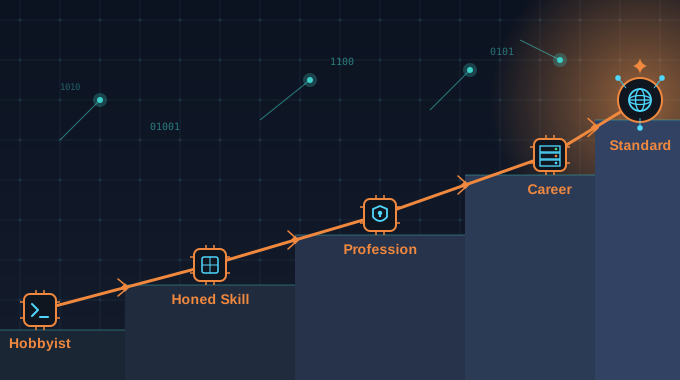
OSINT has moved from a hobbyist's edge to a credentialed discipline.
Eleven years ago, when Cynthia Hetherington founded what would become the OSMOSIS Association, the problem wasn't a lack of skilled people, it was a lack of shared language. Investigators across the country were solving the same problems, inventing the same techniques, and calling them different things. There was no Body of Knowledge. No credentials. No agreed-upon ethics. Just a lot of smart people working in parallel silos.
That's no longer the world we're in. And as President of OSMOSIS, I want to lay out why: OSINT is maturing fast, and it's doing so in a pattern every serious discipline goes through before it earns the label "profession." Capability arrives first. Then governance catches up. Then institutions follow. We're now watching all three stages happen at once.
Stage 1: Capability Arrived First, and It's Not Slowing Down
The tools available to today's practitioner would have seemed like science fiction a decade ago. AI-assisted triage, automated infrastructure discovery, dark web monitoring, and geospatial dashboards are now standard parts of the OSINT toolkit, not novelties. The market reflects it: OSINT has grown into a multi-billion-dollar industry, with fresh funding rounds and enterprise partnerships announced almost monthly.
But more tools and more money don't make a profession. They just raise the stakes. When a skill set scales this fast, the absence of shared standards stops being an inconvenience and starts being a liability for practitioners, for the organizations that rely on them, and for the people whose data is being collected.
Stage 2: Governance Is Catching Up
This is where the real maturation story lives, and it's the part I'm proudest of OSMOSIS having a hand in.
Across the field, we're seeing ethics move from an afterthought to a foundation. The Berkeley Protocol on Digital Open Source Investigations, the UN-backed standard for accountability, privacy, and legal compliance in digital investigations, has gone from a niche reference to required reading. It's now foundational to the OSC (Open-Source Certification) exam and has been cited in the industry as the baseline for responsible practice.
"A decade ago, 'OSINT expert' was a self-declared title. Today, credentials require documented hours, a signed ethics statement, and a proctored exam."
— Ritu Gill, President, OSMOSIS Association
Certification itself is a maturation signal most people underestimate. Credentials like our OSC require:
- 75 documented hours of hands-on experience
- A signed ethics statement
- A proctored exam spanning critical thinking, tradecraft, reporting, and law and ethics
Vendors are moving in the same direction. We're seeing OSINT tool providers publish clearer acceptable-use policies, build customer vetting into their sales process, and get more transparent about data sources and limitations. Trust, not just capability, is becoming the competitive differentiator.
Stage 3: Institutions Are Following
Governments have taken notice. In the U.S., the Intelligence Community OSINT Strategy, the Defense Intelligence Agency's OSINT Strategy, and the State Department's own OSINT strategy all formalize what used to be ad hoc: dedicated tradecraft training, structured industry partnerships, and governance frameworks built specifically for open-source work. What used to be separate and disconnected programs are now synchronizing to benefit the greater whole of U.S. government OSINT work.
Academia has followed, too. OSINT methodology is now the subject of peer-reviewed research, crowdsourced investigation frameworks, and sociotechnical systems for training novice analysts at scale, rather than just practitioner blog posts and conference talks.
And the community itself now has real convening infrastructure. Events like OSMOSISCon give this field something positive: a shared stage to align on standards and showcase emerging tradecraft, instead of every practitioner working it out alone.
Where OSMOSIS Fits
We didn't set out to be a standards body. We set out to solve a much smaller problem: get practitioners talking to each other. But that's usually how it goes. The associations that end up defining a profession's ethics and its body of knowledge rarely start that way — they start as a room of people tired of reinventing the wheel alone.
Today, OSMOSIS is the steward of the OSINT Body of Knowledge and the architect of the OSC framework, precisely because our members demanded rigor before anyone was requiring it of them. That's not a top-down mandate. That's a profession maturing from the ground up.
What This Means for You
If you're a working analyst, this is good news: your expertise is becoming more legible, more portable, and more defensible than it's ever been. A credential like the OSC isn't a hoop to jump through; rather, it's a signal to employers, clients, and courts that your work meets a standard, not just a vibe.
If you're an organization hiring or contracting for OSINT work, the maturation of this field is your risk-reduction opportunity. Ask whether the analyst or vendor you're working with is Berkeley Protocol-literate. Ask whether they're certified. The bar has moved, and it's no longer unreasonable to expect people to clear it.
OSINT stopped being a hobbyist's edge a while ago. The question in front of all of us now isn't whether this field will professionalize — that's already happening. The question is whether you're building your practice to that standard or catching up to it.